

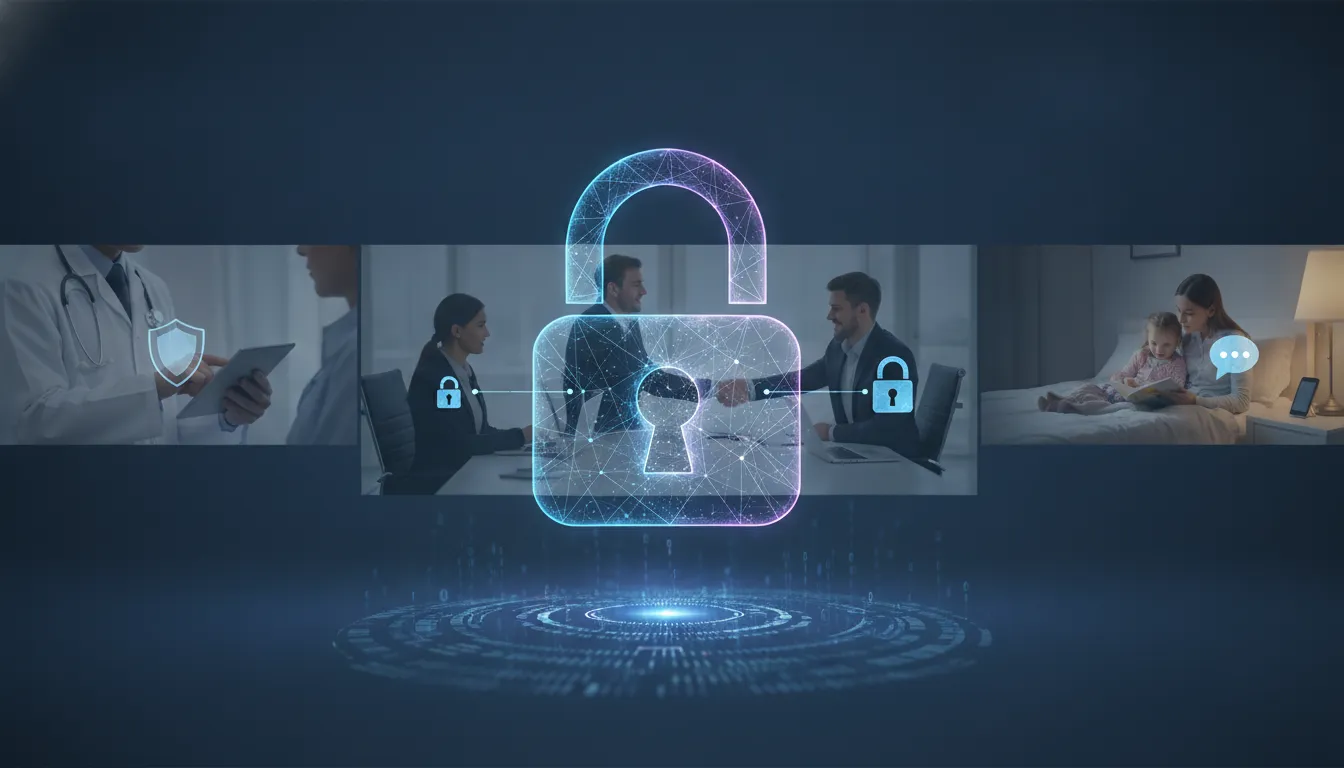
Who Needs Encrypted Communication? Real Scenarios Where Privacy Matters Most
When the topic of digital privacy comes up, the most common response is a variation of the "nothing to hide" argument. If you aren't doing anything illegal, why should you care if internet service providers, tech companies, or advertisers can read your messages?
This argument fundamentally misunderstands what privacy actually is. Privacy is not about hiding bad behavior; it is about protecting what matters. You draw the curtains in your home not because you are committing a crime, but because you do not want strangers watching you eat dinner. You seal envelopes before mailing them because your correspondence is meant only for the recipient.
In the digital world, standard emails and SMS messages are the equivalent of sending a postcard. Anyone handling the message along its route—your telecom provider, the email host, or a malicious actor intercepting public Wi-Fi—can read it. End-to-end encryption puts that postcard inside a tamper-proof, locked briefcase where only the recipient has the key.
So, who needs encrypted communication? The short answer is everyone. But the specific reasons and the level of urgency vary wildly depending on your personal and professional circumstances.
Below, we break down the real-world scenarios where privacy matters most, exploring exactly who needs encrypted communication and why.
Table of Contents
- The "Nothing to Hide" Fallacy
- How Encrypted Communication Works
- 7 Scenarios: Who Needs Encrypted Communication?
- The Limits of Encryption
- How Anonime Supports Secure Communication
The "Nothing to Hide" Fallacy
Before exploring specific use cases, we need to address the baseline. Many people assume encrypted communication is only for hackers, criminals, or secret agents. This stigma discourages average people from adopting tools that could protect their finances, identities, and personal safety.
When you use unencrypted communication platforms, your data is frequently scanned, cataloged, and monetized. Companies parse your emails to serve targeted advertisements. Telecom providers log the metadata of your SMS messages. In the event of a data breach—an increasingly common occurrence—your unencrypted private conversations, passwords, and sensitive attachments are exposed in plain text to whoever buys that data on the dark web.
Encryption removes the profit motive and the vulnerability. It ensures that the content of your communication is mathematically scrambled and unreadable to anyone without the decryption key.
How Encrypted Communication Works (A Brief Primer)
Not all encryption is created equal. When a service claims to use encryption, they usually mean one of two things:
- Encryption in Transit (TLS/SSL): The message is encrypted while traveling between your device and the company's servers. The company decrypts it, reads it (or scans it for ads/spam), re-encrypts it, and sends it to the recipient. The company holds the keys.
- End-to-End Encryption (E2EE): The message is encrypted on your device and remains encrypted until it reaches the recipient's device. The company routing the message never holds the key and cannot read the contents.
When we discuss who needs encrypted communication, we are specifically talking about End-to-End Encryption (E2EE).
7 Scenarios: Who Needs Encrypted Communication?
1. The Everyday User: Protecting Personal Finances and Health
You do not need a high-profile job to warrant privacy. Everyday users routinely send highly sensitive information over digital channels.
The Scenario: You are applying for a mortgage and your broker asks you to email your tax returns, bank statements, and social security number. Alternatively, you are discussing a sensitive medical diagnosis with a family member over a messaging app.
The Risk: Standard email protocols (like IMAP/SMTP) frequently send data in plain text. If your email provider is compromised, or if you are using public Wi-Fi at a coffee shop without a VPN, those tax returns can be intercepted. This leads directly to identity theft and financial fraud.
The Solution: Using encrypted messaging apps for personal conversations and secure, encrypted file-sharing links when transmitting financial documents ensures that only the intended recipient can access the data.
2. Legal Professionals: Safeguarding Attorney-Client Privilege
Lawyers are ethically and legally bound to maintain client confidentiality. The consequences of failing to secure client communication can be catastrophic, ranging from lost cases to disbarment.
The Scenario: A defense attorney is coordinating with a private investigator and sharing evidence, witness statements, and trial strategies regarding a high-stakes corporate litigation case.
The Risk: Corporate espionage is a reality in high-value litigation. If opposing counsel, interested third parties, or malicious actors intercept standard emails or SMS messages, the attorney-client privilege is breached. The unauthorized disclosure of trial strategy can destroy a case.
The Solution: Law firms must use end-to-end encrypted communication for all client discussions and secure enclaves for document sharing. Encryption ensures that even if the firm's network traffic is monitored, the actual communications remain completely unreadable.
3. Healthcare Providers: Maintaining Patient Confidentiality
Medical data is some of the most sensitive and highly regulated information in the world. Regulations like HIPAA in the United States or the GDPR in Europe mandate strict safeguards for electronic protected health information (ePHI).
The Scenario: A therapist needs to consult with a psychiatrist regarding a patient's treatment plan, sharing session notes and medication history.
The Risk: Sharing patient data via unencrypted SMS or standard consumer email violates medical privacy laws. If this data is exposed, the providers face massive regulatory fines, and the patient faces potential discrimination, embarrassment, or targeted scams.
The Solution: Healthcare providers require secure communication platforms that support E2EE and comply with regulatory frameworks. Encrypted communication ensures that sensitive health data is accessible only to authorized medical personnel.
4. Journalists and Whistleblowers: Protecting Sources
A free press relies on the ability of whistleblowers to share information about corruption, illegal activities, or public safety threats without fear of retaliation.
The Scenario: An investigative journalist is contacted by a corporate insider who has evidence of massive environmental dumping by their employer. The insider wants to share internal documents but is terrified of losing their job or facing legal action.
The Risk: If the journalist uses standard email or phone calls, the corporation (or state actors) can easily subpoena communication records or monitor network traffic to identify the source. Once the source is burned, the story dies, and the individual faces severe consequences.
The Solution: Journalists rely on highly secure, encrypted communication channels to communicate with sources. Furthermore, they use techniques like [INTERNAL LINK: Identity Compartmentalization: How to Separate Your Digital Life] to ensure their investigative work is entirely isolated from their personal digital footprint.
5. Business Leaders and Founders: Securing Intellectual Property
Startups, tech companies, and enterprise businesses thrive on innovation. Their intellectual property (IP), trade secrets, and strategic plans are their most valuable assets.
The Scenario: A startup founder is negotiating a merger and acquisition (M&A) deal with a larger tech firm. They are sharing product roadmaps, proprietary algorithms, and financial projections with their board of directors.
The Risk: Competitors or state-sponsored actors frequently target corporate communications to steal trade secrets. If M&A details leak early, it can tank stock prices, ruin the deal, or allow competitors to beat the startup to market.
The Solution: Executives need encrypted communication to discuss strategic maneuvers and secure file sharing to distribute sensitive IP. Encrypted, temporary communication channels are particularly useful here, allowing project teams to collaborate securely and then destroy the channel when the deal closes.
6. Activists and Organizers: Ensuring Safe Assembly
In many parts of the world, organizing a peaceful protest or advocating for human rights can make you a target for state surveillance, harassment, or arrest.
The Scenario: Human rights organizers are coordinating the logistics for a peaceful demonstration, sharing the locations of supply caches and medical tents.
The Risk: Authoritarian regimes and even democratic law enforcement agencies routinely use mass surveillance, cell-site simulators (Stingrays), and social media monitoring to track organizers. Unencrypted communications allow adversaries to map the entire network of activists and disrupt their efforts before they begin.
The Solution: End-to-end encrypted messaging is non-negotiable for activists. It prevents network providers and state actors from reading the content of their planning sessions.
7. Freelancers and Consultants: Managing Client Boundaries
Independent workers juggle multiple clients, projects, and contracts simultaneously. Maintaining professional boundaries and securing client data is crucial for their reputation.
The Scenario: A freelance cybersecurity consultant is conducting penetration tests for three different corporate clients. They need to send vulnerability reports to the respective IT departments.
The Risk: Sending a vulnerability report over standard email is dangerous; if intercepted, it acts as a roadmap for hackers to breach the client's system. Additionally, mixing communications for different clients in one inbox increases the risk of accidentally sending sensitive data to the wrong person.
The Solution: Freelancers benefit from generating specific, isolated communication channels for each client. By using encrypted file sharing and learning [INTERNAL LINK: What is Email Aliasing? How to Hide Your Real Address Online], freelancers can securely deliver sensitive reports while keeping their client identities compartmentalized.
The Limits of Encryption: What It Doesn't Do
While encryption is a powerful tool, it is important to understand its limitations. Encryption is not a magic bullet, and relying on it blindly can create a false sense of security. Never assume that any tool provides absolute anonymity or immunity from tracking.
- Metadata is Still Visible: E2EE hides the content of your message. It does not necessarily hide the metadata—information about who you are talking to, when you sent the message, the size of the file, and your IP address. If an adversary knows you are sending a 5MB file to a journalist at 3:00 AM, the content might not matter.
- Endpoint Compromise: Encryption protects data in transit. If your phone or computer is infected with malware, a keylogger, or spyware, the attacker can read your messages after they are decrypted on your screen. Endpoint security (strong passwords, avoiding phishing, keeping software updated) is just as important as encryption.
- The Human Factor: Encryption cannot stop the person on the other end from taking a screenshot of your conversation and sharing it publicly.
How Anonime Supports Secure Communication
For users who recognize that privacy matters, implementing secure practices shouldn't require an advanced degree in computer science. Anonime is built to help individuals and professionals compartmentalize their digital lives and communicate securely without friction.
Instead of relying on a single, permanent phone number or email address that links all your activities together, Anonime allows you to create Nyms—isolated digital identities. Each Nym can have its own dedicated communication channels.
When you need to discuss sensitive matters, Anonime provides tools for encrypted conversations and secure temporary file sharing. You can establish a secure connection with a client, source, or colleague, share necessary information, and know that the underlying architecture prioritizes minimal data retention. Once a project or conversation is finished, you can cleanly sever that connection, reducing your long-term digital footprint.
While Anonime never claims to provide complete invisibility—no tool can guarantee that—it significantly raises the barrier against tracking, surveillance, and data breaches, putting the control of your data back in your hands.
Summary
Encrypted communication is no longer a niche requirement for spies and whistleblowers. It is a fundamental necessity for modern digital life. Whether you are a lawyer protecting client privilege, a business owner guarding intellectual property, or an everyday user sending tax documents to an accountant, encryption ensures that your private data remains yours. By combining end-to-end encryption with smart practices like identity compartmentalization, you can navigate the digital world securely and confidently.